

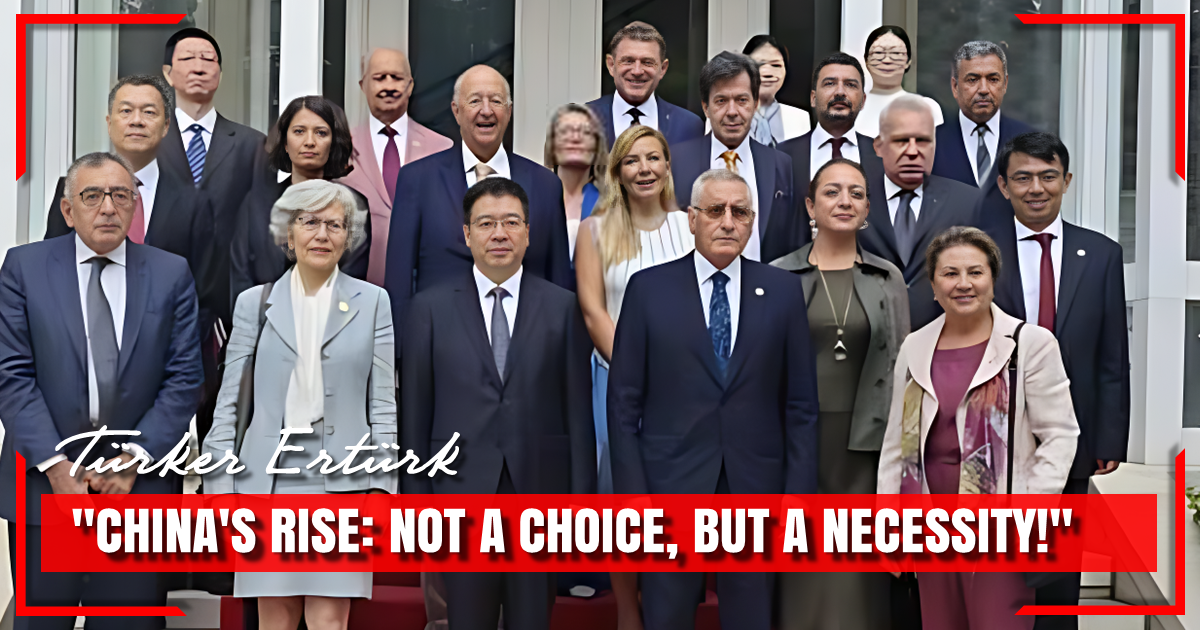
Last week, I joined a trip to China organized by the Turkey-China Friendship Foundation. The delegation comprised 15 individuals, primarily academics from various universities and disciplines. Alongside the academics, the group included two military personnel, a physician, a lawyer, and a psychologist. Among the military members, one was Haldun Solmaztürk, and the other was me. Our journey started with our arrival at Shanghai Pudong International Airport. During the trip, we visited technology companies, robotics manufacturers, smart internet providers, traditional Chinese medicine centers, cultural and tourism sites, think tanks, research institutes, Beijing Language and Culture University, the headquarters of Alibaba—the world’s largest e-commerce platform—and the Museum of the History of the Communist Party of China. We made observations, attended briefing sessions, and received candid answers to our questions. On the final day, we visited the Turkish Embassy in Beijing, where the full staff was present.
Evaluating this approximately one-week trip overall, it’s hard not to be impressed by China’s technological development, economic growth, modernization, and progress. The residential areas we saw were spotlessly clean, traffic flowed smoothly, people followed rules, and the environment remained verdant. We traveled the Hangzhou-Beijing route on a high-speed train reaching speeds of 370 km/h.
China and the US
China is currently the world’s second-largest economy. Based on purchasing power parity, it has overtaken the US (30.5 trillion dollars) with a figure of 40.7 trillion dollars. China’s per capita income stands at 13,000 dollars, significantly lower than the US’s 85,000 dollars per capita, yet its growth rate, estimated at around 7-8% annually, is nearly double the US’s 3-4% (IMF, 2025). China is not merely growing; it is a developed nation that continues to advance rapidly. As is well known, growth and development carry different meanings. Economic growth is defined as an increase in a country’s total production (Gross Domestic Product). Development, however, is more comprehensive, encompassing far more than economic growth. It includes social, cultural, economic, and environmental dimensions. Development involves the wise use of resources, taking into account people’s quality of life, education levels, access to healthcare, equality, personal freedoms, and the needs of future generations.
When comparing the economies of China and the US, China emerges as an investment, production, and manufacturing-focused developing economy, rapidly advancing toward high technology and surpassing its rivals in some areas. The US, by contrast, is a consumption, service, innovation, and technology-driven developed economy. In the short term, the US leads in nominal size; in the long term, China leads in purchasing power. The two economies are deeply interdependent, and their rivalry will shape the 21st century’s global economic order. Additionally, according to the US News & World Report’s 2025-2026 “Best Global Universities” rankings, 15 Chinese universities are ranked among the world’s top 100.
National Capitalism
China did not reach this point effortlessly. It was a region where various colonizers roamed freely. Nevertheless, it possessed a profound historical depth. As highlighted in Joseph Needham’s Science and Civilisation in China, China’s historical technological superiority from the 1st century BC to the 15th century AD forms the foundation of its current successes. However, the architect of today’s developed and modern China is widely regarded as the reformist statesman Deng Xiaoping, who led the country from 1978 to 1989. Deng’s economic philosophy was encapsulated in a pragmatic saying: “It doesn’t matter if a cat is black or white. As long as it catches mice, it’s a good cat.”
Deng argued that a planned economy or a market economy was merely a tool for resource allocation and had no connection to political institutions. In other words, socialism could adopt a market economy, and capitalism could adopt a planned economy. While visiting the Museum of the History of the Communist Party of China, the phrase “National Capitalism” caught my eye. Indeed, today in China, a planned, national capitalism operates under the control of the Communist Party, and this lies at the heart of China’s success story. Unfortunately, in our country, we are burdened with an unplanned, non-national, crony capitalism that leads to the plundering of our resources.
Meritocracy
One of the most significant features of China’s success is the meritocratic nature of its state structure. Meritocracy is a form of governance where administrative power is based on merit. In this system, authority is distributed among individuals deemed to possess superior qualities, with no favoritism involved. This system, aligned with Confucian philosophy, forms the foundation of effective governance.
There are lessons we can learn from China in this regard. China exports approximately 42 billion dollars’ worth of goods directly to Turkey annually. In return, we sell only 3.5 billion dollars’ worth of goods to China. When we include exports made through third countries, China’s total exports to Turkey reach around 50 billion dollars. The disparity is significant, and the challenge lies with us. To address this, we need structural reforms and strategic cooperation with China.
Religion in China
Another noteworthy observation I made in China is that despite being a hardworking, rule-abiding, and moral society, there is no visible religion in social and public life. China is the cradle of some of the world’s oldest and most continuous philosophical and doctrinal traditions. China has never developed a concept of religion that directly corresponds to the Western understanding. The schools of thought that began to emerge from the 6th century BC onward have remained original and continuously evolved within themselves.
Thus, as belief systems in China, the schools of thought that have shaped Chinese culture throughout history—Confucianism, Taoism, and much later Buddhism—are typically listed. These intertwined schools of thought, while not carrying a radically different understanding of the universe among themselves, are fundamentally distinct from the religions of Judaism, Christianity, and Islam that emerged in the West. Although different sources provide varying figures, it is generally estimated that today, approximately 52% of China’s population is non-religious, 22% follow Traditional Chinese Religion, 18% are Buddhist, 5% are Christian, 2% are Muslim, and 1% follow other religions.
China’s Baggage is Empty, the US’s is Full!
I had visited almost every country in the West, but until last week, I had never been to China. This trip provided me with the first opportunity to get to know the Chinese people up close. Initially, I noticed that everyone I met—from the lowest-ranking official to the highest, including local senior officials of the Communist Party—was non-arrogant, modest, smiling, and easy to collaborate with.
Another characteristic of China is its approach to cooperation, which is based on mutual benefit, trust, respect, and non-interference in internal affairs. Unfortunately, the same cannot be said for our ally the US and the EU. China does not carry the baggage of having colonized countries, exploited their resources, staged coups to change regimes, or bombed nations in its past. However, the US, including in Turkey, is attempting to reshape the region, pursuing new political maps, and envisioning regime changes through proxy forces.
New World Order
Following the Cold War (1949-1990), a unipolar world order was established under US leadership. This order, which is based on hegemony rather than mutual respect, trust, and benefit in international relations, seeks to crush those who resist, disregards rules and law, pursues regime changes, and aims to reshape the entire world and draw political maps, is characterized by violence and ruthlessness. The so-called “New World Order” is neither fair, equal among nations, nor sustainable.
The First Gulf War (August 2, 1990 – January 17, 1991) opened the door for the US-led West to use military force recklessly without competition or opposition from another power, and this trend continued subsequently. Despite the collapse of the Soviet Union and the disappearance of its original purpose, NATO developed new enemy definitions, effectively transforming from a defense pact into an attack pact. After the Soviet period, NATO expanded toward Moscow by accepting former Warsaw Pact states as members, taking advantage of Russia’s economic difficulties and instability.
The Grand Chessboard
Zbigniew Brzezinski, one of the world’s most renowned strategists who served as National Security Advisor to President Jimmy Carter from 1977 to 1981, outlined in his book The Grand Chessboard the geostrategic necessities for the US to maintain global supremacy and continue as the world’s sole superpower. He stated, “Russia must be divided and fragmented,” pointing to the need for a move involving Ukraine to achieve this. Otherwise, the security of Ukraine and Ukrainians was of no concern to the US.
The Greater Middle East Project, the Arab Spring, and the proxy wars and interventions that followed, which destabilized the region, were not carried out by China or Russia. In fact, Turkey, one of the 32 NATO countries, remains among the most affected by the wars, instabilities, and mass migrations resulting from the US’s destabilization of these regions.
Why Become Enemies Just Because They Want It?
NATO has evolved from a “defense alliance” into an “attack alliance” pursuing the US’s strategic interests and objectives. At the same time, it maintains control over the countries within the alliance. This observation belongs to French President Charles de Gaulle. NATO’s first Secretary General, Lord Ismay, famously said, “NATO was created to keep the Russians out, the Americans in, and the Germans down.” What was true for Germany yesterday remains valid today for all of Europe and its members in terms of keeping them under control.
China, Russia, and Iran are countries Turkey must maintain good relations with. Why should we become enemies with these countries or hesitate to cooperate with them just because the US wants it, or because NATO, which has become an instrument for the US’s strategic goals, demands it?
The Center of Gravity is Shifting East
Brzezinski, in his The Grand Chessboard, warned that “the potentially most dangerous scenario for the US would be a large coalition of China, Russia, and perhaps Iran, formed not by ideology but by an anti-hegemonic reflex.” Today, what Brzezinski feared has materialized. The formation of the Shanghai Cooperation Organization, BRICS, and even the Global South is a result of the US’s hegemonic, overbearing, and lawless policies, creating a scenario more dangerous and polarizing than Brzezinski’s prediction.
The US recognizes that the world’s economic and political center of gravity is shifting from the Atlantic to the Asia-Pacific region and understands that the global order is evolving from unipolarity to multipolarity. To halt these developments, it continues to rely on its superior military power and involves NATO in this effort.
Multipolarity Means Balance
Whether the US likes it or not, developments are leading the world toward a multipolar order, that is, balance. This process requires more hardship and time. A balanced situation has not yet been achieved today. In this environment of imbalance and uncertainty, protecting Turkey and preventing it from being exploited should be the primary duty of the governments ruling the country. We must recognize that a multipolar world order serves the interests of both Turkey and our planet.
Conclusion
In conclusion, China’s rise presents strategic opportunities for Turkey, particularly in areas such as economic diversity, technology transfer, and geopolitical balance. Considering the US-China artificial intelligence competition, China’s superiority in hypersonic and robotic systems, its high-speed rail networks, urban transformation and smart city projects, electric vehicles and infrastructure, digital economy, and 5G technology, cooperation with China is crucial for Turkey not to miss out on such modern developments. A partnership with China could also balance the imbalanced trade relations between Turkey and China.
Acknowledgments
I would like to extend my gratitude to Hasan Çapan, President of the Turkey-China Friendship Foundation, who organized this trip to China; Eda Lermi, Legal Advisor of the New World Research Center, who successfully managed all administrative tasks to ensure the trip’s success; Psychologist Görkem Güller; and Cumhuriyet Newspaper columnist Mehmet Ali Güller.
I also feel honored to have been part of the group that participated in the trip and represented our country in the best possible way as a cohesive team: Prof. Dr. Hasan Ünal, Director of the New World Studies Center from Başkent University; Prof. Dr. Seriye Sezen from Ankara University; Prof. Dr. Ersin Kalaycıoğlu from Sabancı University; Sema Kalaycıoğlu from Işık University; Ret. Gen. Dr. Haldun Solmaztürk; Dr. Altay Atlı from Koç University; Turkologist and Former MP Hüseyin Kocabıyık; Dr. Ayşe Göbel Çakmakçı; Prof. Dr. Hayri Kozanoğlu from Altınbaş University; Prof. Dr. Taşansu Türker from Ankara University; and Prof. Dr. Pervin Somer from Okan University.
Türker Ertürk
